GZA
APP
GZA came from one shared vision across my cofounders, our team, and me: invest in the future of Georgia and the wider region. The webpage is the introduction. The real work is the national education platform behind it: AI career guidance, focus sessions, real exam mocks, info hub, university hub, human-curated content operations, privacy, and regional architecture.
Study
01
A student OS
for Georgia.
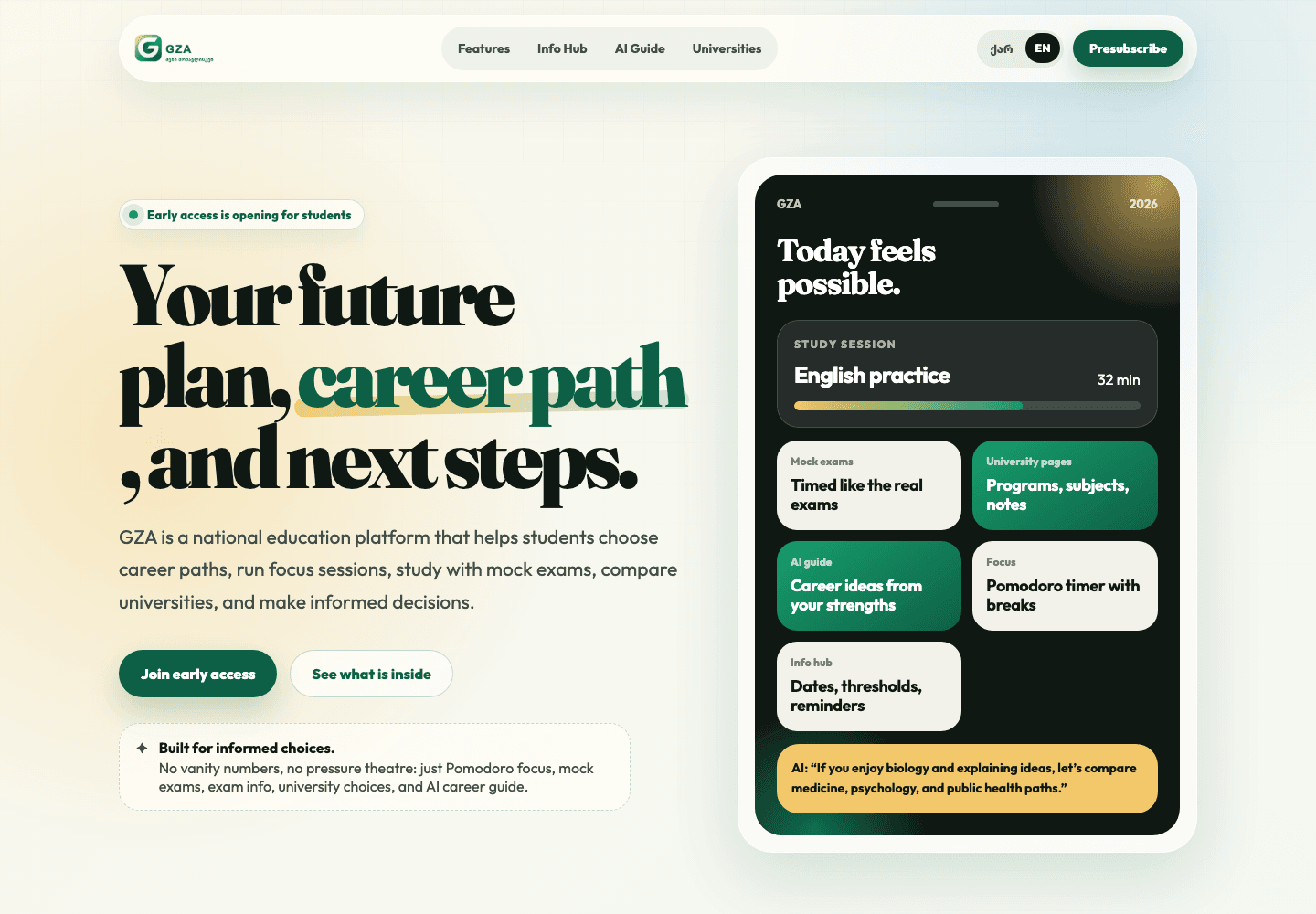
GZA is a national education platform for Georgian students who are trying to understand exams, universities, focus, and career direction in one place. The waitlist is live, the platform is launching in September 2026, and the product exists because students still have to gather life-changing information from old PDFs, scattered school advice, private tutors, and random screenshots.
- ProductCareer · focus · mocks · uni · info
- AppExpo 54 · React Native 0.81
- BackendFastify · PostgreSQL · Redis
- ContentHuman-curated content · PDF import
The Market Gap
Georgian students need more than practice questions. They need one reliable place for exam dates, verified mocks, university requirements, focus rhythm, and career direction before the decision window gets loud.
The Product Logic
GZA is built as a loop: understand the destination, focus for a session, take a real mock, read the result, compare university paths, then come back with a clearer next move.
The Platform
The app is Expo and React Native, the backend is Fastify with PostgreSQL, Redis, BullMQ, JWT admin routes, and the PDF document import pipeline converts human-curated source documents into typed bundles that can ship locally or remotely.
National platform.
Decision support.
The product is built around a student asking: what should I do next? Sometimes that means a focus session, sometimes a mock exam, sometimes university comparison, and sometimes the AI career guide needs to turn a vague interest into a concrete path.
AI Career Guide
The guide is the orientation layer: interests become fields to explore, subjects to strengthen, university programs to compare, and questions worth asking before applying.
Pomodoro Focus
The study timer is tied to subjects and session history, so focus data becomes part of the student record instead of disappearing inside a generic timer app.
Real Mock Tests
Mock exams preserve NAEC-style pressure: timed sessions, question navigation, audio groups, gap-fill handling, paragraph matching, answer state, and result review.
Info Hub
Exam dates, thresholds, reminders, scholarships, admission criteria, and data-safety guidance sit in one student-language hub instead of scattered tabs and PDFs.
Uni Hub
University profiles connect programs, required subjects, campus information, admissions notes, and student questions back to the career and exam-planning loop.
These modules follow the actual Expo app logic: a subject-linked Pomodoro screen, real national mock tests with timed state, a combined information and university discovery surface, and an AI career guide that connects choices back to a useful next step.

Pomodoro Focus
Real Mock Tests
მოსმენის დავალება ინახავს კონტექსტს ზემოთ, პასუხები იცვლება ქვემოთ.
Info / Uni Hub
Career Guide
I like biology and design, but I do not know what professions exist.
Start with uncertainty
A student arrives with a broad interest, a subject they may or may not like, and no clean view of where the path leads.
Choose a useful next task
GZA turns the question into one concrete action: focus, mock, compare, read, shortlist, or ask the career guide for better options.
Measure the attempt
The app records focus sessions and mock results locally, then turns completion, score, time, and answer review into practical feedback.
Connect it to a future path
Results are not isolated. They connect back to universities, required subjects, and career decisions so studying has a visible purpose.
Built like infrastructure, presented like help.
GZA has to feel calm, but the implementation is serious: typed domain models, local and remote content modes, authenticated admin routes, cache-aware delivery, analytics aggregation, privacy consent, data deletion, and production smoke checks.
Mobile App
Bottom-tab navigation gated by consent and onboarding. Local-first state keeps the core experience usable while remote content can be enabled later.
Content API
Human-curated, high-quality content bundles are loaded by region, sanitized, versioned, cached in memory and Redis, and backed by PostgreSQL active-bundle records.
Operations Layer
The landing waitlist, admin-protected content routes, analytics ingestion, BullMQ aggregation, health checks, and EAS/Railway deployment paths form the operating spine.
Landing
Vercel waitlist
Expo app
local/remote content
Fastify API
content + analytics
PostgreSQL
bundles + aggregates
Redis
cache + queue
Document import
PDF documents
The hard part is not the screen. It is trusted content.
GZA needs official-feeling exam behavior without pretending to be official NAEC infrastructure. The pipeline exists so human-curated, high-quality content can be imported, validated, published, cached, rolled forward, and expanded by region without shipping a new mobile build for every update.
Upload
Exam PDF, answer key, optional audio
Parse
Subject parser or YAML GenericMCQ config
Validate
Question ids, answer coverage, OCR warnings
Bundle
Typed JSON / TypeScript content bundle
Publish
Admin upload, active version, cache invalidation
Deliver
Local, remote, or fallback_local app mode
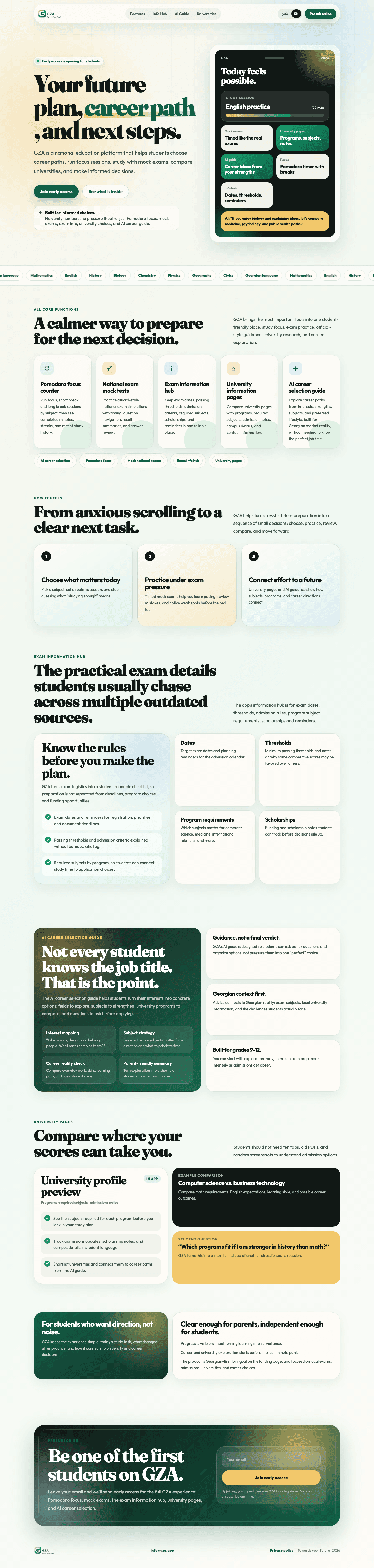
The landing page introduces the product and collects early access while the private app, backend, audio assets, and admin code stay outside the public deployment. Visitors can open the live gateway directly from the preview tab.
Minors-first consent
The app starts with privacy consent, age bracket logic, guardian confirmation for younger students, and a versioned privacy notice.
Local data boundaries
Sensitive state is persisted through chunked SecureStore writes. Students can delete personal data and optionally keep anonymized statistics.
Retention policy
Study sessions and mock results are retained for 730 days, then folded into anonymized aggregate insights instead of kept forever.
Analytics redaction
Backend analytics ingestion redacts personal numbers, emails, and phone-like values before events enter the processing queue.
Georgia first.
Then region by region.
GZA starts with Georgia, expands through the Caucasus, and then grows toward Kazakhstan and Turkey as larger adjacent education markets. The common pattern is the same: students in decision years need exam readiness, career direction, university comparison, focus rhythm, and trusted information before the final application window gets loud.
student decision years across five expansion markets
teachers around the same student system
student, parent, and teacher guidance ecosystem
The thesis is simple: these markets still do not have one native-language student layer that combines real national-exam mocks, university discovery, career guidance, parent clarity, and school-facing trust in one place.
Georgia
644.2K general-school pupils · 66.3K teachers
195.4K higher-ed students
64 HEIs · 45 private HEIs
Launch market, Georgian-language content, NAEC-style mocks, university pages, and parent trust layer.
Armenia
406K general-school pupils · about 30K teachers
72.1K higher-ed students
53 HEIs · 30 private · 8 accredited private
First neighbor market once exam logic, Armenian-language guidance, and university data are mapped locally.
Azerbaijan
1.7M+ general-school pupils · 150K+ teachers
246.5K higher-ed students
51 HEIs · 10 non-state/private
Large native-language opportunity where students, parents, and schools still navigate fragmented admissions information.
Kazakhstan
3.9M+ school pupils · 412K teachers
624.5K higher-ed students
113 HEIs · ≈64 private HEIs
Central Asian bridge market with UNT pressure, Kazakh/Russian-language localization needs, and a private-heavy university landscape.
Turkey
18.0M formal pupils · 1.19M teachers
6.7M higher-ed students
208 HEIs · 79 foundation HEIs
Scale expansion market where YKS pressure, program discovery, career clarity, and parent guidance can become a much larger ecosystem.
Free student access. Paid institutional value.
The base product stays free for students, because the network only grows if students actually use it. Revenue comes from the places that benefit from better-informed choices: universities that need clearer program discovery, and later companies that want to explain real career paths earlier.
Free for students
The base product stays free because the platform only works if students trust it as useful infrastructure, not another gated education product.
AI Career Guide upgrade
The optional paid layer gives students deeper career mapping, subject strategy, program comparison, and parent-friendly summaries.
University pages
Universities become the main revenue channel: private or foundation institutions in Georgia, Armenia, Azerbaijan, Kazakhstan, and Turkey are the first page-market targets.
Company pages
Companies can later publish career pages tied to fields of study, helping students see where programs lead and helping employers reach future talent early.
The result is a mutual-benefit ecosystem: students get a free national platform, parents and teachers get clearer decision support, universities get high-intent discovery, and companies can later connect education choices to real employment pathways.
Georgia foundation
Start with Georgia's 9-12 decision years: about 176K students in the latest grade-level table, plus parents and teachers who influence every university and career decision.
Free student layer
Keep the core platform free for students: mocks, Pomodoro, Info Hub, Uni Hub, reminders, and the base planning experience. The optional upgrade is the deeper AI Career Guide.
Caucasus expansion
Move into Armenia and Azerbaijan only with native-language content, local exam mapping, local university data, and local legal review. The same centralized student hub gap appears across the region.
Kazakhstan bridge
Kazakhstan becomes the first wider-region bridge: a larger Kazakh/Russian-language market, strong school digitization, UNT-style exam pressure, and a higher-ed system with heavy private participation.
Turkey expansion
Turkey is the scale market. The product would need Turkish-native UX, OSYM/YKS exam mapping, university-discovery localization, and career-guide outputs that fit a much larger high-school and university system.
Company pages
Add employer pages after the university layer: students discover fields earlier, universities explain programs better, and companies can show real career paths before students choose a direction.
Rounded market figures are used for product sizing. GZA is an independent education platform for student decision support and does not present itself as official exam infrastructure.
Built by a team
with one direction.
GZA is founded and developed by a dedicated team from day one. Everyone shares the same vision for the future development of our region, bringing professional expertise in product, engineering, operations, design, and law so students can make clearer decisions about their future.